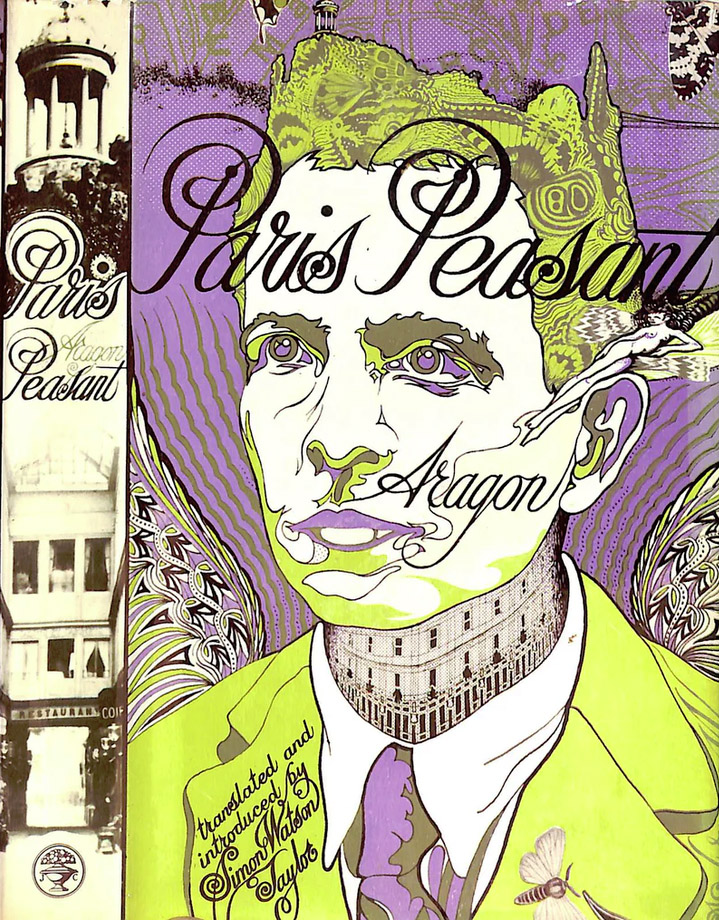
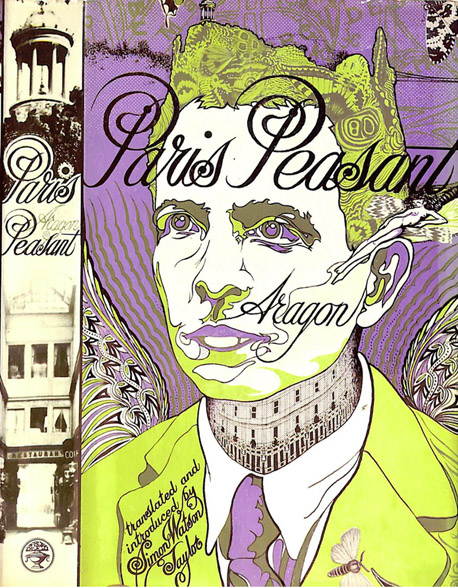
 -
- translated by TAYLOR, Simon Watson
222 pages, Jonathan Cape 1971, 8 x 5 1/2"
Jacket design by Stanley CHAPMAN
"Before psychogeography, the Situationists and dream urbanism, there was Paris Peasant, a pioneering Surrealist excavation of the twentieth century's capital city.
Paris Peasant (1926) is one of the central works of Surrealism, yet Exact Change's edition is the first US publication of Simon Watson Taylor's authoritative translation, completed after consultations with the author. Unconventional in form--Aragon consciously avoided recognizable narration or character development--Paris Peasant is, in the author's words, "a mythology of the modern." The book uses the city of Paris as a stage or framework, and Aragon interweaves his text with images of related ephemera: café menus, maps, inscriptions on monuments and newspaper clippings. A detailed description of a Parisian arcade (nineteenth-century precursor to the mini-mall) and another of the Buttes-Chaumont park, are among the great set pieces within Aragon's swirling prose of philosophy, dream and satire. André Breton wrote of this work: "no one could have been a more astute detector of the unwonted in all its forms; no one else could have been carried away by such intoxicating reveries about a sort of secret life of the city...."
text from: thecarycollection.com/products/paris-peasant-taylor-simon-watson
"For every image, each time it occurs, forces you to revise the whole Universe."
This is one of my favourite quotations about images, and it is often attributed somewhat imprecisely.Louis ARAGON was a French poet and writer; he was one of the founders of the Surrealist movement in the early 1920s, alongside André BRETON, before later becoming associated with communist politics and writing some of France's greatest love poetry.
The quotation comes from Le Paysan de Paris (The Peasant of Paris, 1926), one of the key texts of early Surrealism.
The original French reads:
"Car chaque image à chaque coup vous force à réviser tout l'Univers."
A literal translation would be:
"For every image, each time it occurs, forces you to revise the whole Universe."
or perhaps even more naturally:
"Every image compels you, each time anew, to rethink the entire universe."
Dutch version,
"Elk beeld dwingt je, iedere keer opnieuw, het gehele universum te herzien.
What did Aragon mean?
In Surrealism, an image is not merely a picture or a photograph. It is any unexpected conjunction of ideas, objects, or perceptions that suddenly reveals reality differently.
For Aragon, an authentic image does not simply represent the world—it changes the world.
When a genuinely new image appears, it overturns the mental framework through which we understand reality. The universe itself has not changed, but our relationship to it has.
This idea became one of the cornerstones of Surrealist aesthetics:
- imagination is not decorative;
- metaphor is not ornament;
- a true image is an act of discovery.
As André BRETON later argued in the Manifesto of Surrealism, the strongest images arise when two distant realities are brought together, producing a flash of insight that reason alone could never reach.
Why I think this quote is especially interesting for photography
Aragon was speaking primarily about poetic images — those created by language and imagination.
Photography extends his insight into another domain. A remarkable photograph doesn't merely show something that already exists. It can permanently alter how we see: a face, a landscape, a historical event or even the ordinary objects around us.
After certain photographs, we can no longer look at the world in quite the same way. In that sense, every truly powerful photograph does force us to 'revise the whole universe.'
It strikes me as one of the finest one-sentence definitions of what transformative images are capable of doing.
One small detail that makes it even richer is Aragon's choice of words. He does not write voir ('to see') or regarder ('to look'). He writes réviser.
Today, réviser usually means 'to revise' or 'to review' (as students revise for an exam), but its deeper sense is literally 'to see again' (re-viser). It suggests that every genuine image obliges us to look again, to reconsider what we thought we knew.
That is remarkably close to the aim of the I Can See project. We are not trying to teach people how to look at photographs; we are trying to teach them how to see. Aragon is saying that a true image interrupts habitual seeing and demands a new vision of reality.
It also reminds me of a remark by the art historian John BERGER in 'Ways of Seeing': "Seeing comes before words."
Berger begins with the act of seeing itself. Aragon goes a step further: every authentic image changes what seeing is.
Another fascinating connection is with Ernst GOMBRICH, who argued in Art and Illusion that we never simply see the world — we see it through expectations and mental 'schemata'. A powerful image disrupts those schemata, forcing us to revise them. Although Gombrich wrote from cognitive psychology rather than Surrealism, he arrives at a surprisingly similar insight.
For this course, I would even consider using Aragon's original French alongside the English translation:
"Car chaque image à chaque coup vous force à réviser tout l'Univers."
The French has a compact, almost explosive rhythm. It feels less like an observation than a declaration.
And if I may make one prediction: I suspect that as we continue developing 'I Can See', this sentence may become one of its guiding principles. It encapsulates —in just eleven French words— the idea that images do not merely reflect reality; they actively reshape the reality we inhabit. That's a profoundly humanistic idea, and one that still feels fresh a century after Aragon wrote it.
(text is edited from ChatGPT)
see slide: # 25-26